
Silver Mine Reclamation
Field Study -- Reclamation Of Silver Mines in the san juans
By Luke Danielson
Luke Danielson, President of Sustainable Development Strategies Group, and WARM’s Executive Director Dominique Naccarato were among the leaders of a field course to study reclamation needs and current actions at mine sites in the Four Corners region of New Mexico, Colorado, Utah and Arizona. The field course was organized by the Western Alliance of Reclamation Management, https://www.westernreclamation.org/ and the Society of Economic Geologists, https://www.segweb.org/ and mostly based at Fort Lewis College in Durango, Colorado.
We saw numerous types of mining in several different settings, from copper mining in Utah to former uranium mines on the Navajo Nation to, which will be the subject of future blog posts.
The focus of this post is the legacy of mining in the San Juan Range of Colorado, specifically the region around Silverton, Colorado. While this includes mining of zinc, lead gold, copper, and other minerals, the most frequent and visible mining impacts are those of silver mining. Future blogs will focus on other parts of the field trip.
We had much help and support from a variety of experts and organizations, without whom the field course could not have been conducted. We want to thank particularly David Gonzales, WARM Board Chair, Kirstin Brown of the Colorado Division of Reclamation, Mining and Safety, and Ann Maest of Buka Environmental.
Silver has been mined for at least 5,000 years. There is clear evidence of silver mines in what is now Turkey at 3,000 BCE.
Early prospectors in western Colorado discovered considerable silver deposits in the 1870s. But most of these deposits were on lands guaranteed to the Ute people under the Ute Treaty of 1868, also known as the “Kit Carson Treaty.” The reservation encompassed nearly 16.5 million acres.
But pressure from prospectors and mining interests and railroads increased. In 1878, Colorado’s first elected Governor, Frederick Pitkin, ran for office on the slogan “the Utes Must Go.” After the 1879 Meeker Incident and subsequent military conflict, the Utes were indeed removed, and settlers of all kinds, including miners, rapidly moved in.
Major silver deposits were located at Leadville, Aspen, Ouray, Lake City and Silverton. The federal government decided to stimulate and subsidize the silver industry. The Bland-Allison Act of 1878 required the Treasury to purchase between two and four million dollars of silver each month to be circulated as silver dollars.
The Silver Boom
Colorado (and other western states) experienced a massive silver mining boom. The increase in the money supply with the great influx of silver dollars led to an ‘easy credit’ economic environment, very conducive to western settlers and the development of the West. Inflated United States currency made farmers and other debtors very happy, and banks and other creditors unhappy
Silverton proved to be a major mining center.1 Its Mayflower Mill alone produced some 30,000,000 ounces of silver. There were numerous silver mines, many of them large mines by the standards of the day.
And the pressure on government to continue subsidizing silver continued and grew, culminating in the Sherman Silver Purchase Act of 1890, which increased the Treasury’s mandatory silver purchases, and paid for silver in notes redeemable either in silver or gold. Companies sent silver to the mint, and received gold in payment at a fixed ratio of 1 ounce gold for 16 ounces of silver. It was such a good deal for silver miners that the mint started to run out of gold. Something needed to change.
The Silver Bust
What changed was the advent of the Silver Panic of 1893, the most severe depression the country had ever experienced, with bank and business failures (over 500 banks failed), high unemployment, and a run on the nation's gold reserves.
Silver mining shrank dramatically. Colorado experienced mine closures, mass unemployment in silver-mining towns like Leadville (where unemployment reached 90%), business failures, and social unrest, including violent labor strikes.
“By September 1893, the Colorado Bureau of Labor Statistics reported that 377 businesses had failed, 435 mines had closed, and 45,000 people were out of work.”2 Denver was flooded by unemployed miners. Despite valiant efforts, including construction of tent cities, it was not possible to provide decent housing or adequate food for the army of unemployed.
Many of the mines in the San Juan silver districts such as Silverton closed, and never reopened. In that era, there were no mine reclamation requirements. And practices were simply to leave mines in whatever condition they were in when economic conditions caused their closure.
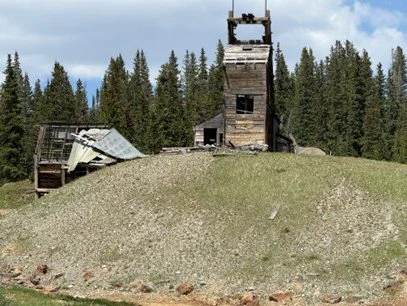
Abandoned silver mine on Red Mountain Pass
Hundreds of mines were abandoned in whatever condition they were in when the bills could no longer be paid. There are over 700 in San Juan County alone.
Acid Formation
The rock formations in this region contain considerable amounts of sulfur, and are prone to form sulfuric acid, and create conditions for acid rock drainage, or “ARD,” ARD results in the mobilization of metals such as lead, arsenic, cadmium, and other elements that are toxic to humans, fish, and other species. Once the conditions are established for generation of ARD, it can continue for a very long time. In the Rio Tinto in Spain, ARD continues today from mines developed by the Phoenicians. The extreme acidity (around pH 2) is toxic to most life and requires extensive treatment to mitigate.
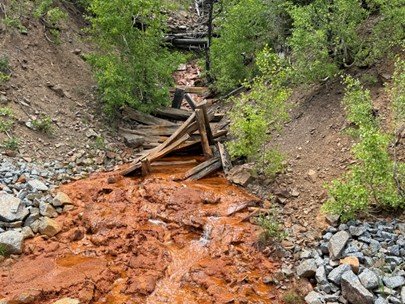
Acid drainage from abandoned mine near Silverton
The many abandoned mines in the Silverton area have continued to have considerable impacts on water quality for decades. In most cases, there was very little done to remediate conditions at these sites.
About a decade ago, an EPA contractor doing a remedial investigation in the Gold King Mine above Silverton accidentally breached an earthen berm that was retaining water in the mine. This led to a major spill of contaminated water from the underground workings.[1]
The public reaction to this massive spill led to EPA action. It was clear that remediation of the Gold King alone would not result in much improvement in water quality. Ultimately, the Environmental Protection Agency designated a Superfund Site, called the Bonita Peak Mining District Site,[2] that includes 48 historic mining properties.
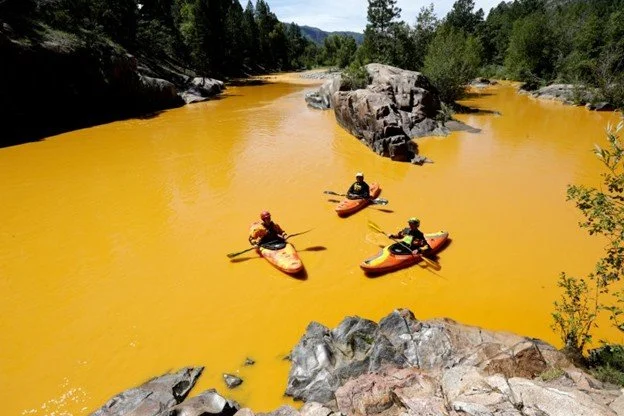
Impacts of the Gold King spill on the Animas River near Durango, Colorado
Field course participants toured the Gold King Mine, and met with responsible EPA officials, including EPA Remedial Project Manager Joy Jenkins.
Participants engaged in an intensive study of acid drainage, and its impacts on stream health. They learned sampling techniques for stream biota.
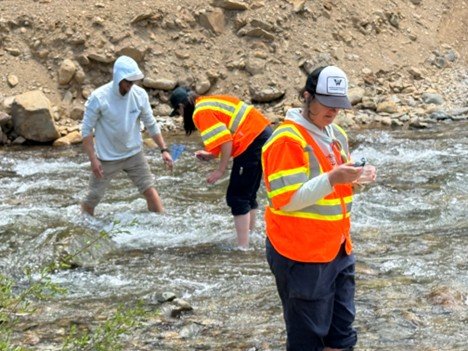
Participant evaluations of the course were uniformly positive. And some lessons were learned that can make future field courses in the area more efficient and more productive.